
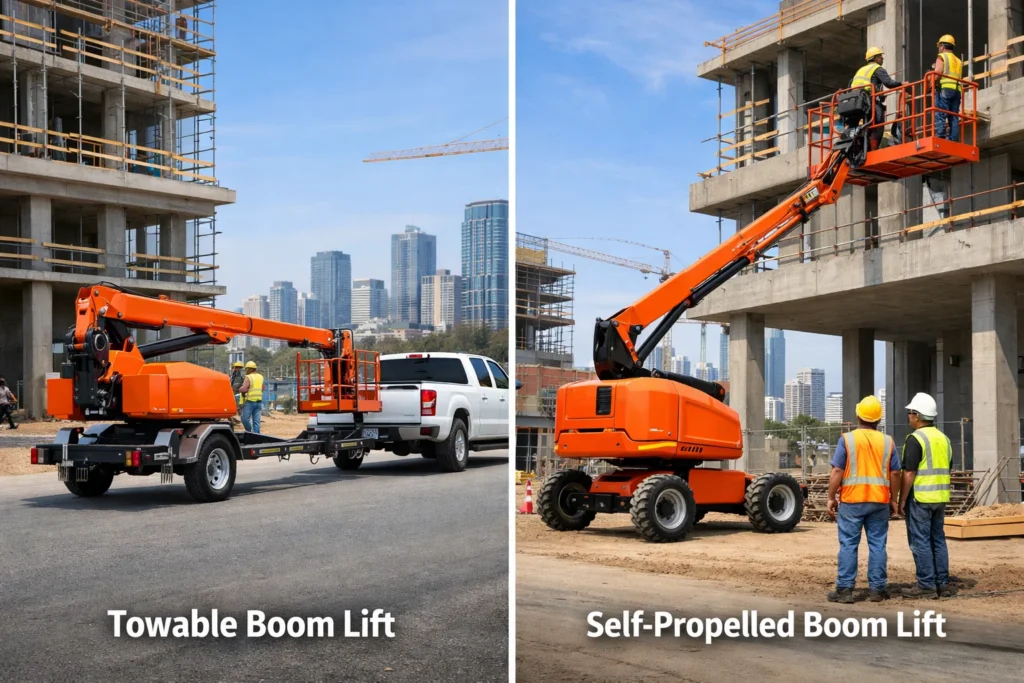
If your job or service requires working at height, a boom lift is the right equipment to use. It is available in two options in the market: towable boom lifts and self-drive (self-propelled) boom lifts. Both are used to lift workers and tools to a height but differ in movement, installation, features and so many other things. Read this article till the end to know the key differences between towable boom lifts vs self-drive boom lifts and buy or rent the right one for yourself.
What Is a Towable Boom Lift?
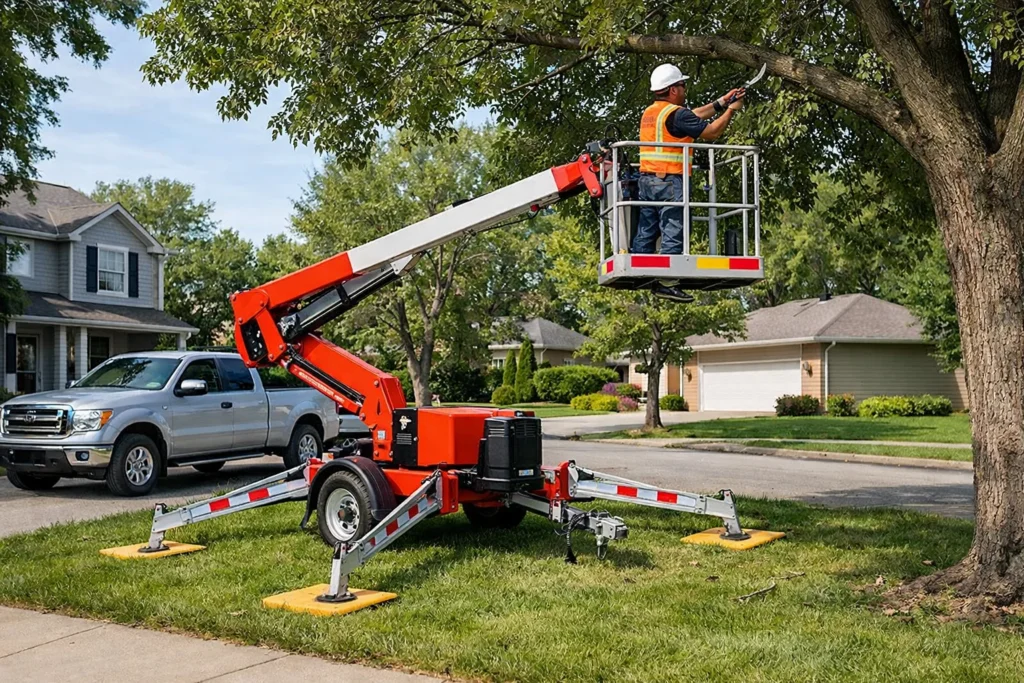
A towable boom lift is a compact and trailer-mounted aerial lift platform designed for movement and access to a height. It can be pulled by a normal pickup truck or SUV and installed in 5-10 minutes. The machine uses a hydraulic articulation or telescopic arm to lift upward and outward.
- How It Works: A hydraulic pump moves the boom up, down, and sideways. It extends its 4 legs on the ground and raises the wheels slightly. This position keeps the lift stable on grass or gravel. The operators control the lift from the platform using simple buttons and joysticks.
- Towing Mechanism: This lift is connected to a vehicle with a trailer hitch and safety chains. It means you don’t have to carry a separate transport truck along with it. Once you’re on-site, you can unhitch and start doing your work.
- Typical Working Height & Load: The majority of towable lifts have lifting heights between 12 and 22 meters and a load capacity of about 200 kg.
- Common Applications: Predominantly used in tree trimming, roof repairs, painting, signage work, and residential projects.
What Is a Self-Drive (Self-Propelled) Boom Lift?
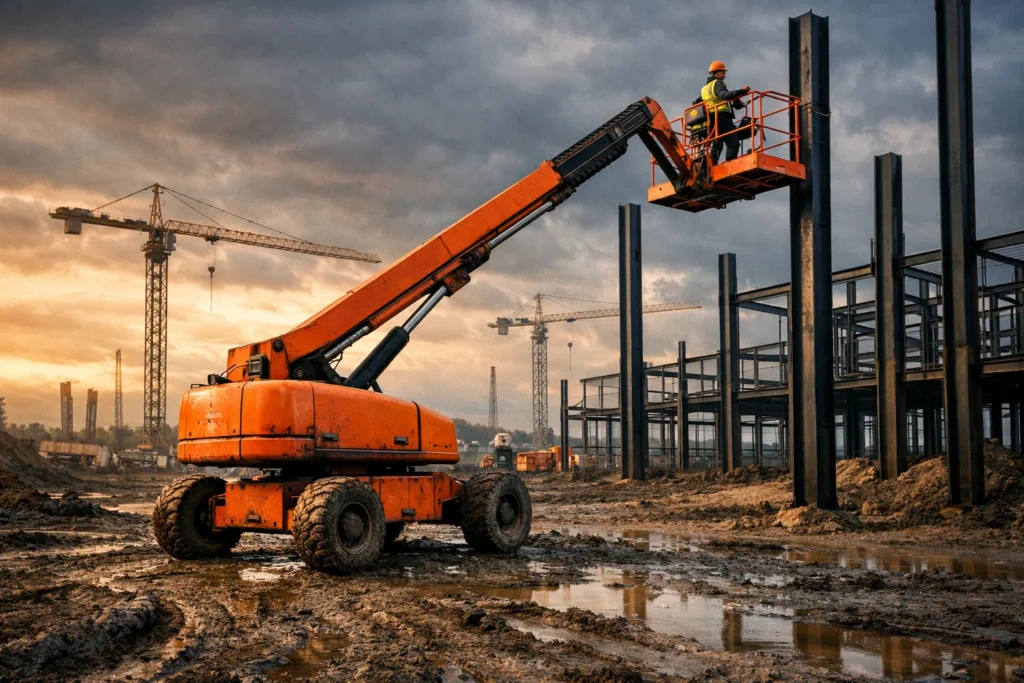
A self-drive boom lift, also known as a self-propelled lift, is an aerial platform that can move and change its position without being towed. The operator stands in the basket and operates it from there. They can reach heights of 10 to 55 meters based on the model. As this lift can be repositioned while the platform is raised, it doesn’t interrupt the workflow.
- Drive System: It has an onboard motor or engine in it. Electric models run on batteries. They make very little sound and are safe for indoor work. Diesel models have more power and traction. They can lift over rough ground, slopes, and outdoor surfaces. At last, hybrid models are both electric and diesel.
- On-Platform Controls: The basket has an easy-to-use control panel with joysticks and buttons. From the basket, the operator can drive, control, and raise or lower the boom light with accuracy.
- Indoor & Outdoor Usage: Electric self-drive boom lifts are suitable for indoors, whereas the diesel self-drive boom lifts are best for open construction sites and slippery surfaces.
- Typical industries: You can see them in construction sites, warehouses, telecom work, industries, infrastructure repair, landscaping, and events.
Safety Features Comparison
Safety is one of the primary considerations when you compare a towable boom lift vs. a self-drive boom lift. Both machines are equipped with a couple of safety features, as the manufacturer doesn’t want to leave any room for error. Although these lifts have many similar features, they are not all the same.
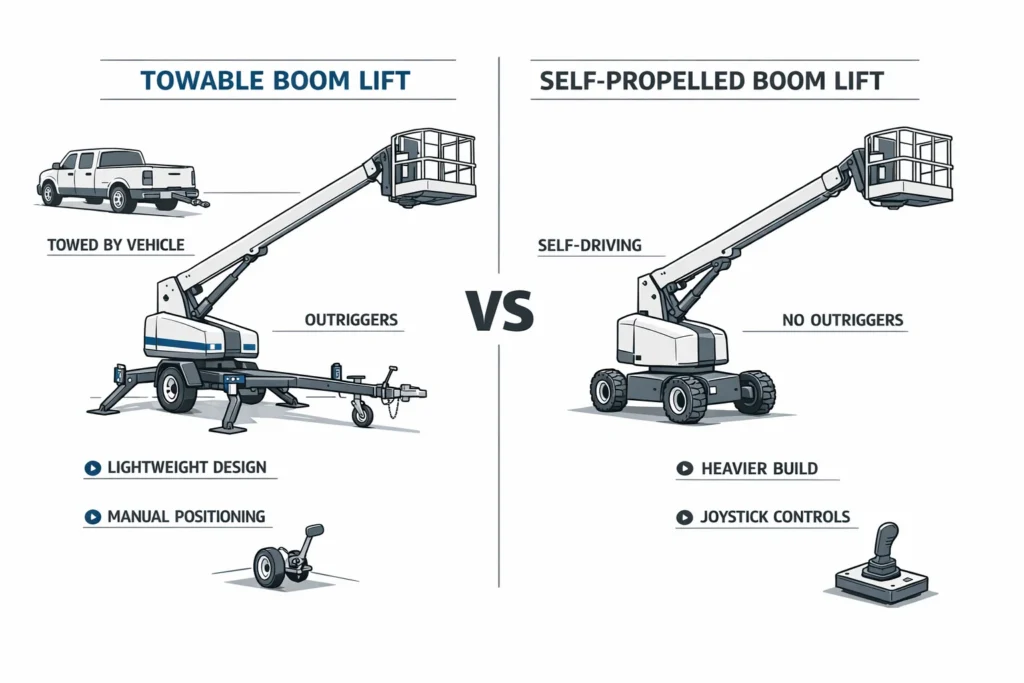
Towable Boom Lift Safety Features
- Hydraulic outriggers won’t start the machine until everything is set up properly
- Automatic leveling sensors keep the foundation stable
- Load sensors stop in between if the weight limits are exceeded
- Emergency stop buttons and manual lowering valves make them more secure during a power failure
- Triple braking system improves towing and parking safety
- Guardrails and anti-collision protection protect the operator
- Trailer lighting and brake systems improve road transport visibility
Self-Drive Boom Lift Safety Features
- Tilt alarms warn operators if the lift is on unstable terrain
- Overload protection restricts the unsafe basket weight
- Precision proportional controls reduce sudden movements
- Emergency lowering systems provide a controlled descent
- Guardrails and harness anchor points prevent falls
- Zero tail swing designs reduce collision risks
Cost & Maintenance Comparison
Most buyers focus on the price first. Both lifts have different pierce tags depending on the model. And before you buy any one of them, you should consider the maintenance costs of them.
- Brand New vs. Rental: Towable boom lifts are cheaper than self-drive models. They are also cheap to rent. Even if the self-drive lifts cost more, they are worth the investment when used heavily because their on-site movement doesn’t waste time and doesn’t delay the project.
- Maintenance Differences: Towable lifts are simple to maintain, as they have few parts to service. However, self-drive units include motors, drive components, and advanced controls that require routine checkups before use and professional servicing.
- Long-Term Considerations: Before buying a lift, you should definitely consider the storage, transport, inspections, and resale value. Towable lifts are easier to store and maintain. Moreover, self-drive lifts demand more maintenance but deliver great productivity for active fleets.
- Fuel, Battery, and Service Costs: Electric models cost less to run daily but need battery care and occasional parts replacement. Diesel units consume more fuel and require engine servicing. Maintenance is important because it affects both performance and safety.
Which Boom Lift Should You Choose?
We know it is difficult for a buyer to differentiate the towable boom lift vs. the self-propelled lift. The right choice can save you from wasting your hard-earned money on the wrong choice.
Choose Towable Boom Lift if…
- You have to travel between multiple jobsites and towing should be easy
- Projects are short-term, occasional, or seasonal
- Quick setup and removal in minutes
- You want cheap rental, transport, and maintenance costs
- The surface of the job site is flat
Choose Self-Drive Boom Lift if…
- The job requires frequent repositioning at height
- The site is large, busy, or spread out
- Terrain is uneven, muddy, or rough
- Productivity and speed are more important than cost
- Crews work long hours in the same location
To Sum Up
There are worlds of difference between a towable boom lift and a self-drive boom lift. Which one you buy or rent depends on where you work, how often you move, and how much you plan to spend. The right choice at the end will make your work productive, secure, and convenient. If you’re looking for a high-quality lift manufacturer, trust Himor Lift. We have 23+ years of experience, projects in 30+ countries, and offer a 5-year structural warranty. Contact us at +86 13026586831 or [email protected].
FAQs
1. What is the main difference between a towable boom lift and a self-drive boom lift?
Ans: The key difference between a towable boom lift and a self-drive boom lift is how they move and operate on a job site. A towable boom lift is pulled by a truck or SUV and is not movable after setup, while a self-drive boom lift has its own motor and can drive around the site, even while the operator is in the basket.
2. Which boom lift is cheaper, towable or self-drive?
Ans: Towable boom lifts are usually cheaper to buy and rent than self-drive boom lifts. Because they can be towed by a pickup or SUV, it reduces the expensive transport or delivery fees.
3. Can a towable boom lift be used indoors?
Ans: Yes, a towable boom lift can be used indoors but only if it is electric. Before buying one, you should check that it fits through doorways and has non-marking tires to protect your floors.
4. Are self-drive boom lifts safer than towable boom lifts?
Ans: Both machines are equally safe when they are used correctly, maintained properly, and operated within their limits. In real job conditions, safety depends more on operator training and setup than on the type of lift itself.
5. What working height can a towable boom lift reach?
Ans: A normal towable boom lift is within 12 m and 22 m (about 30 to 60 feet), which is suitable for residential and basic commercial work. The most common range is around 12–15 m (40–50 ft), ideal for 2- to 3-story buildings, tree trimming, painting, and gutter maintenance.