
What if your parking space didn’t compete with your living space? Today, the real challenge is not owning a car. It is to find a good spot to park it. Traditional parking consumes a lot of space, ruins the design of your home, and often feels like a compromise. In such situations, a hydraulic car elevator is the best solution. You don’t have to expand your house to install one. It can be done with the unused space within your house. Let’s find out how it works and what makes it worth considering.
What Exactly is a Hydraulic Car Elevator?
A car elevator is a heavy-duty, vertical, and hydraulic lift designed to lift vehicles vertically between different floors of a building. Car elevators date back to the 1920s, when cities like Chicago and New York had a shortage of parking space. In 1923, Westinghouse introduced the first model of car elevator, and by 1925, Peter Lunati’s hydraulic lift changed everything. These lifts have now become a symbol of luxury living.
So, how does it work? It’s quite simple. You drive your car onto a platform, select the level, and the system lifts or lowers the vehicle using hydraulic or traction technology. They are used in several areas. For example, in luxury villas, they allow homeowners to park cars right inside their homes. However, car elevators are very different from passenger elevators. They are rugged, big in dimension, and durable to handle heavy vehicle loads.
How Does a Car Elevator Work?
A car elevator runs in a systematic way, and there are many components in it that make it possible. Let’s break down the process that powers this system and makes vertical car movement a piece of cake.
Step 1: Entry & Positioning
The process starts as you drive onto a platform. Visible markings over the floor or sensors help you park your car straight. This helps in weight distribution.
Step 2: System Activation
Once parked, the system is activated using a button, key switch, or even a remote. At the same time, a PLC (Programmable Logic Controller), the “brain” of the elevator, checks weight limits and safety conditions before allowing movement.
Step 3: Lifting Mechanism in Action
In hydraulic systems, a pump pushes oil into a cylinder to raise a piston that lifts the platform. Whereas, in traction systems, motors, cables, and counterweights work together to pull the platform upward.
Step 4: Vertical Travel
The platform moves along strong guide rails and keeps it firm and stable. Also, it has a feature called “automatic leveler,” which keeps the platform aligned with the destination floor.
Step 5: Safety Check
There are multiple safety features, such as overload sensors, emergency brakes, and mechanical locks, to prevent sudden drops or imbalances. If anything is off, the system won’t move until it’s fixed.
Step 6: Exit
Once the platform reaches the desired level, doors open, and you can drive out.
Types of Car Elevators
The market is flooded with different types of car elevators. But only three types are top sellers. Below is a buyer-focused breakdown of the three most popular options:
1. Car Lift Platform
A car lift platform is a hydraulic-powered system built with a strong steel structure and guided by rails. It’s widely used in homes, garages, warehouses, and commercial buildings to move vehicles between floors. With a lifting capacity of 1000 kg to 10 tons and heights up to 15 m, it is suitable for any vehicle from personal cars to heavy vehicles.
It comes with built-in features such as anti-drop devices, safety cylinders, and emergency stop systems. It can be installed with or without a pit, which makes it flexible for both new and existing spaces. If you want a reliable, heavy-duty, and customizable solution, this is a strong choice.
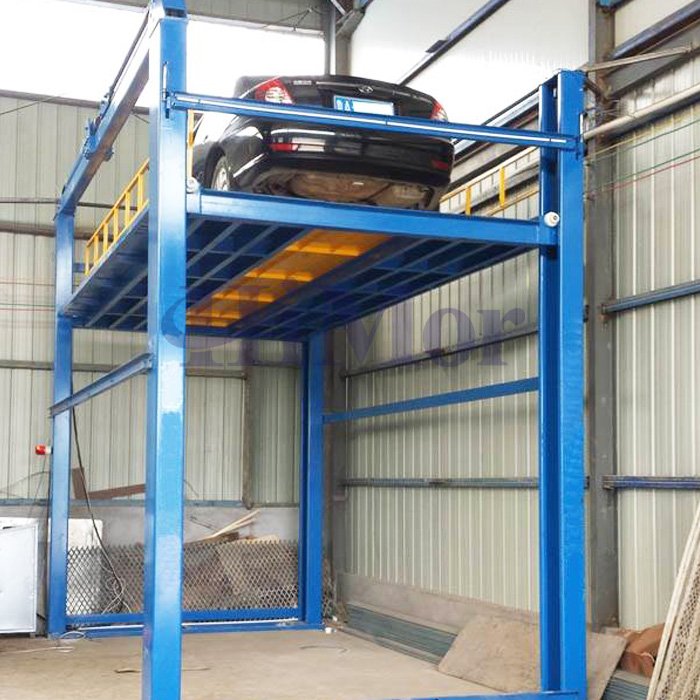
2. Car Lift Table
The car lift table uses a scissor-style hydraulic mechanism. It’s ideal for low- to mid-rise lifting (2–6 meters) and is commonly installed in basements or underground garages. This system requires a pit installation, which helps keep the platform flush with the ground.
One of its biggest advantages is versatility. It supports loads from 1000 kg up to 100 tons and even offers double-deck designs for stacking vehicles. You can see features like anti-skid platforms, emergency controls, and low maintenance; it’s perfect for buyers looking for a cost-effective and space-saving solution.

3. Car Turntable
A car turntable rotates your vehicle 360 degrees. It solves one of the biggest parking challenges: tight spaces. Installed in driveways, garages, and showrooms, it allows drivers to enter and exit without reversing.
Powered by an electric motor and built with heavy-duty steel, it supports 1 to 20 tons and offers adjustable rotation. It’s also a popular choice for car displays and luxury homes. If your problem is space, a turntable is a game-changing upgrade.

Key Benefits of Installing a Car Elevator
Parking can quickly turn into frustration, especially when space is limited. At this point, a car elevator moves your car up or down, makes better use of your space, improves safety, and adds ease to your everyday routine. Let’s look at the key benefits that make a car elevator an excellent choice:
Increase Parking Space in Narrow Areas: Car elevators use vertical space. This means you can double or even triple your parking capacity without expanding your property. You don’t have to install bulky ramps. You get more usable space for your basements, narrow plots, and urban homes.
Enhances Property Value and Luxury Appeal: A car elevator instantly upgrades your property’s image. It adds a premium feel that attracts modern buyers and tenants. In many cases, it can boost property value and turn it into a long-term investment.
Improves Safety and Vehicle Protection: No steep ramps, no blind turns, no risk of scratches. Car elevators come with advanced safety features like sensors, locks, and controlled movement to ensure your vehicle stays secure and damage-free at all times.
Time-Saving and Highly Convenient: Just drive in, press a button, and you’re done. No circling for parking, no navigating tight corners. It’s quick, smooth, and designed for hassle-free daily use.
In Summary
Is a car elevator worth it? The answer is yes. It turns unused vertical space into parking and removes the hassle of ramps. A car elevator makes the most sense for luxury homes, compact plots, car showrooms, and buildings. It adds comfort, safety, and a premium feel. It’s important to choose the right manufacturer of hydraulic lifts, and no one is better than Himor Lift. We have more than 23 years of experience in manufacturing hydraulic lift solutions. Serving 30+ countries with strong local support, we deliver quality you can rely on. Plus, enjoy a 5-year warranty on the main structure. Send us a message for a free quote!
FAQs:
1. Can a car elevator be installed in a home?
Ans: Yes, a car elevator can be installed in a home. Many systems are designed for retrofitting, especially pitless or compact models. However, proper space, structure strength, and layout planning are important. A professional inspection helps in installation without major changes.
2. How safe is a car elevator for daily use?
Ans: Car elevators are designed with multiple safety features like sensors, emergency stop buttons, and overload protection. When installed and maintained properly, they are very safe for daily use. Regular servicing also keeps the system reliable and risk-free over time.
3. How much space is required to install a car elevator?
Ans: The space depends on the car size and lift type you choose. Generally, you need enough room for the platform, movement area, and safety clearance. Compact designs are available for smaller spaces, making them suitable even for tight urban homes.
4. Does a car elevator consume a lot of electricity?
Ans: No, modern car elevators are designed to be energy-efficient. Hydraulic systems, in particular, consume power mainly during lifting. With proper usage, the electricity cost remains reasonable and does not significantly impact your overall energy bills.
5. Can a car elevator increase property value?
Ans: Yes, installing a car elevator can boost your property’s value. It adds a luxury feature, improves parking convenience, and attracts premium buyers. In urban areas where parking is limited, it can be a strong selling point.