
If you have a factory or warehouse and need to move goods between different floors, manually carrying them up and down stairs is obviously not a wise choice. Freight elevators are expensive and cannot be installed independently. In this case, a guide rail-mounted cargo lift is a good solution.
When you search online, you’ll find that guide rail hydraulic lifts are divided into single-rail and double-rail types. Judging from appearance alone, it’s impossible to determine which design best suits your needs. A single-rail lift consists of a set of guide rail cylinders and a working platform, while a double-rail lift consists of double-sided guide rail cylinders and a working platform. Other hydraulic and electrical control systems are the same. What are the differences between the usage, the safety performance, and the prices?
Himor Machinery, a company from China, has been engaged in the research and development and production of hydraulic lifting platform equipment for over twenty years. Next, we will guide you from a professional perspective to understand and learn how to choose between a single-rail and double-rail freight lift.
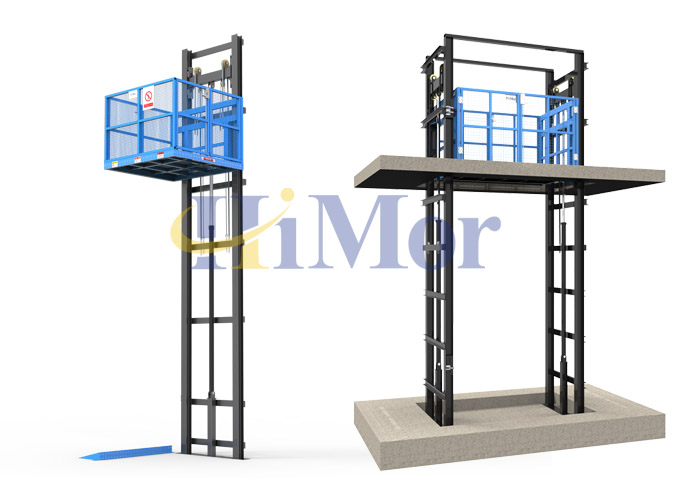
Firstly, let’s consider the design of the hydraulic lifting platform itself.
The choice between single-rail and double-rail mainly depends on the weight and size of the goods you want to lift. Therefore, we need to discuss the load capacity and worktable size of the guide rail lifting platform. The load capacity of a double-sided guide rail lifting platform is greater than that of a single-sided one. If the cargo weight is less than 1 ton and the cargo size is less than 1500mm*1500mm, you can choose a single-rail lifting platform. If either the weight or size requirement exceeds these standards, you need to choose a double-rail lifting platform. For example, if your cargo weighs 800 kg and the size is 2000mm*2000mm, you need to choose a double-rail lifting platform; or if the cargo weighs 3000 kg and the size is 1300mm*1300mm, you still need to choose a double-rail lifting platform. Some special load capacity and worktable requirements require customized design by our designers.
Secondly, and this is also important, is guard rail cargo lift budget!
If the load capacity and worktable size meet the requirements, a single-rail lifting platform is preferred because firstly, the product cost itself is lower, and secondly, the costs of sea freight, customs clearance, and inland transportation are lower. It can truly alleviate your financial burden and is more economical. Purchasing a 3-meter single-rail lifting platform from Himor costs approximately $3000 USD.
How to DIY a hydraulic cargo lift platform?
Before purchasing, you need to discuss your on-site usage and installation environment with the Himor sales team. For example, the size of your factory or warehouse installation space, the requirement for a 20-30cm thick hardened surface, the typical height of your goods, whether a safety net is needed, and the opening direction of the safety net door, etc. We will help you solve these problems from a professional perspective.
Of course, regardless of whether you ultimately choose a single-rail or double-rail lifting platform, we will provide specialized installation videos and manuals, as well as professional and attentive after-sales service.
Our high quality is reflected in the details of our products:
High-performance copper guide rails;
work platform with safety lock door;
plug-in cables;
freight elevator safety signs;
powder coating process for all elevator parts;
anti-slip steel platform; galvanized wheel chains;
first-class limit switches;
high-quality safety wire ropes;
digital control panel, etc.
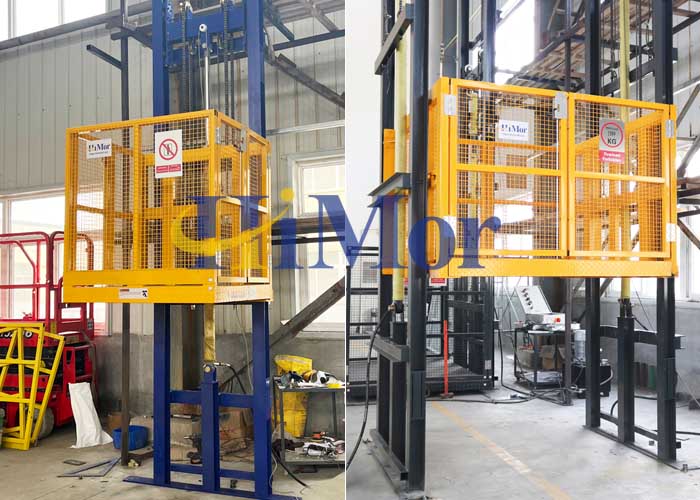
Shandong Himor Machinery, through more than 20 years of R&D and production, has summarized a set of professional production processes and standards. We consistently maintain high standards and strict requirements, earning a high market share through customer word-of-mouth.
FAQS:
- What are single-side and double-side guide rail lifts?
Single-side guide rail lifts have rails on one side of the platform, while double-side guide rail lifts have rails on both sides. The rails guide and stabilize the platform during movement.
- 2. How do I decide based on load capacity?
Single-side lifts are suitable for smaller loads lower than 1000kg.
Double-side lifts are better for heavy loads as they provide more stability and prevent swaying.
- 3. Does cargo size or shape influence the choice?
Wide, heavy, or asymmetrical cargo generally requires double-side guide rails.
Smaller or uniformly shaped loads can work safely with single-side rails. It is better for a pallet size lifting like 1200mmX1200mm.
- 4. How does lift height affect the decision?
For high-rise lifts, double-side guide rails offer better safety and stability. We suggest the lifts higher than 3 floors to use double sides lifts.
Single-side rails are usually sufficient for low to medium-rise installations like 2-3 floors.
- 5. What about space constraints?
Single-side lifts need less shaft space, suitable for compact areas. Even if there is only 1m by 1m space, you can install a single-side cargo lift.
Double-side lifts require more space but improve stability for heavy or tall cargo.
- 6. Are there cost differences?
Single-side guide rail lifts are usually cheaper to install and maintain.
Double-side lifts have higher initial costs but reduce wear and improve long-term reliability.
- 7. Which is safer for frequent or industrial use?
Double-side guide rails are safer for high-frequency or heavy-duty operations. If in some situation, the lift needs to work 7X24 hours, you must choose double-side lift.
Single-side lifts are acceptable for lighter, occasional use. Most clients use the single-side lifts in their shops, homes, warehouses etc.
- 8. Does the type affect leveling and stopping accuracy?
Double-side guide rails typically allow more precise leveling, important for automated loading/unloading. Both lifts required balance loading, and unbalance loading is forbidden.